Before deployment
01Know who is ready for the role.
Organize responder identity, affiliation, qualifications, teams, roles, and access before an incident starts.
Use AIGIS Command to maintain responder qualifications, run accountability workflows, and retain supported assignments, shifts, and service history.
AIGIS Field
Responds
Mobile response
AIGIS OPS
Coordinates
Live desktop operations
AIGIS Command
Prepares · Accounts · Retains
Browser readiness, accountability, and records
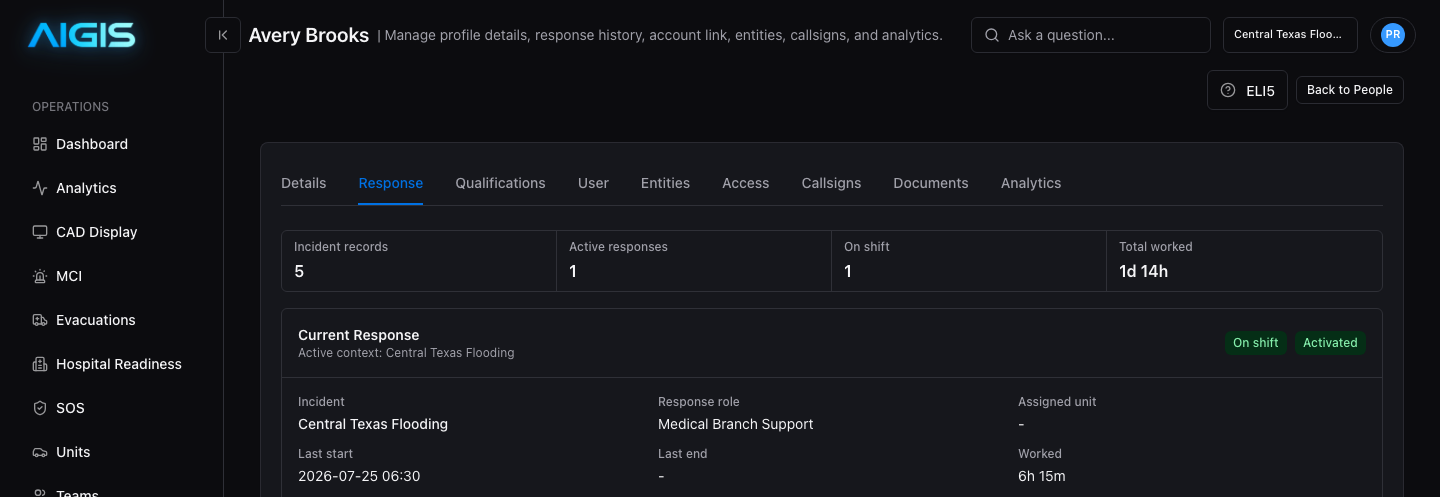
Representative operational data shown in the working AIGIS Command interface. No production responder records are pictured.
Before deployment
01Organize responder identity, affiliation, qualifications, teams, roles, and access before an incident starts.
During the incident
02Keep PAR, incident personnel, assignments, shifts, issues, and operational documentation in view.
After the operational period
03Retain incident assignments, response roles, recorded shifts, elapsed duty time, qualifications, and recent supported activity.
Build an operational responder record from facts your organization maintains: identity, affiliations, qualifications, training, teams, callsigns, and access.
Readiness is calculated from recorded qualification attributes against a selected TX EMTF role profile. AIGIS does not claim automatic issuing-authority or license validation.
Explore Responder Readiness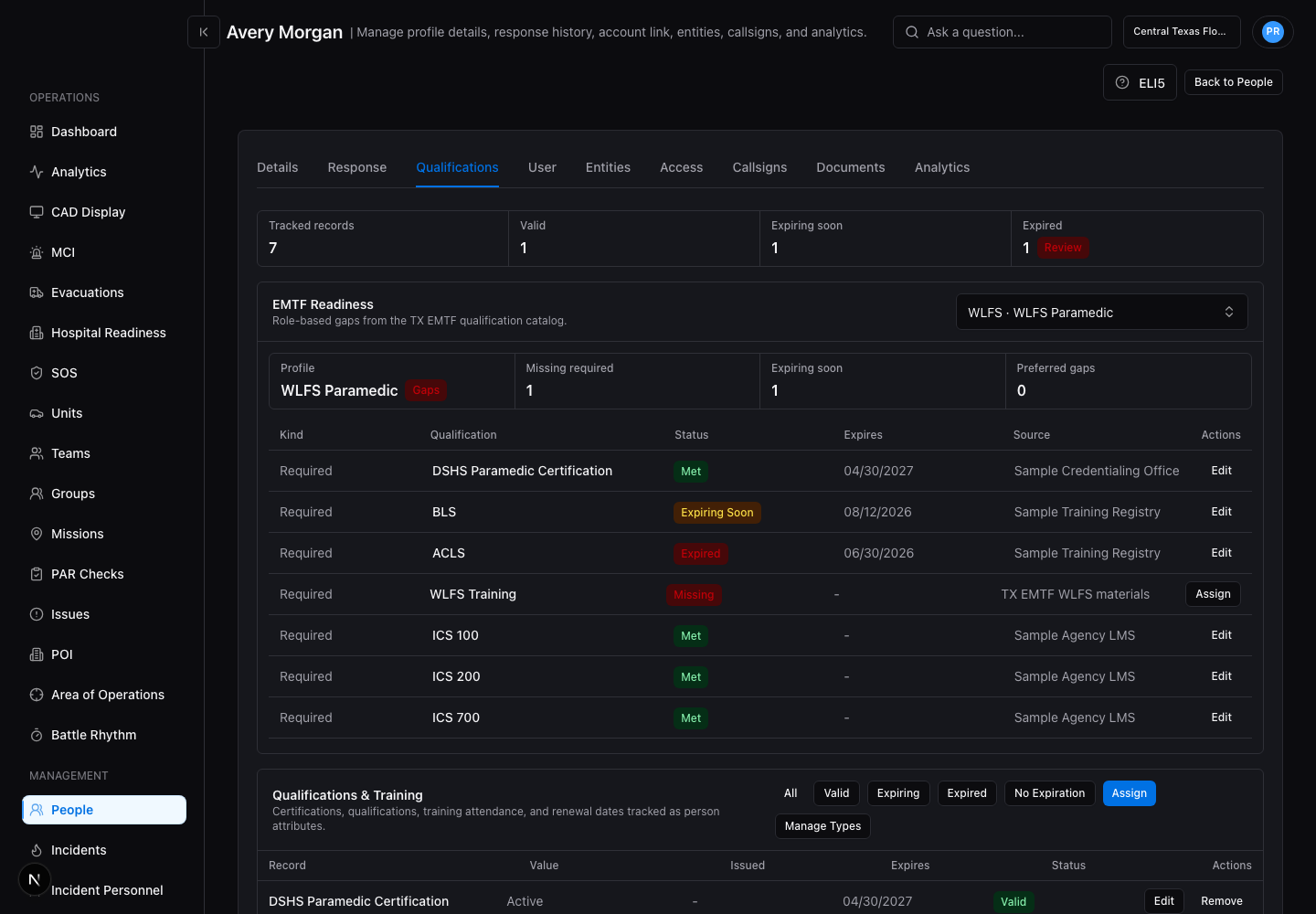
Deterministic fixture data in the implemented role-readiness workflow. No production responder records are pictured.
Personnel, teams, units, missions, channels, areas, and accountability records stay scoped to the selected incident.
Explore Staffing & AvailabilityActive incident
Central Texas Flood Response
Structure
Coordinate
Account
Retain
PAR responses, missing ICS 214 dates, staffing outreach, and assigned issues stay visible in Command.
Explore Incident AccountabilityRun PAR requests, see response state, and keep unanswered checks visible to command.
Review incident personnel and shift-linked ICS 214 records, including expected report days, submissions, completion, and missing dates.
Keep assigned issues, staffing outreach, reporting work, and recurring operational events in view.
Sanitized example data in the implemented People and response workflows.
Keep the recorded relationship between each responder, the incident, their assigned role, and supported response activity.
Service history is limited to recorded operational facts. Evaluations and private personnel notes are not included.
Explore Responder Service Record
Ask the supported unit-response question in plain language, receive the distinct unit count, and inspect the cited mission-history rows before acting.
See the supported Command workflowAsk the system
How many units have responded in the last hour?
Operational answer
AIGIS returns the supported answer with its underlying operational rows so the operator can check context and recency.
Access and governance
Bundle permissions into reusable roles and apply access within an entity or across authorized entities.
Link responder and user records, activate or deactivate access, and support authenticator-app MFA with SMS fallback.
Review audit events on supported surfaces with action, timestamp, actor or system source, scope, and captured details.
Request access using your responder roles, supported qualification profiles, teams, incident structure, and accountability workflow.