
Personal response task
The outreach link opens a focused availability page rather than asking the responder to navigate the Command workspace.
Choose responders, define the dates, and send an incident-scoped request by SMS and email. Responders select the specific dates they report as available from a personal link; Command tracks the replies and keeps assignment work in the same workspace.
Fixture-data product view. “Suggested” and Fit are operator-review cues derived from responder-reported requested dates and maintained record attributes. They are not AI recommendations, credential verification, readiness determinations, or assignment decisions.
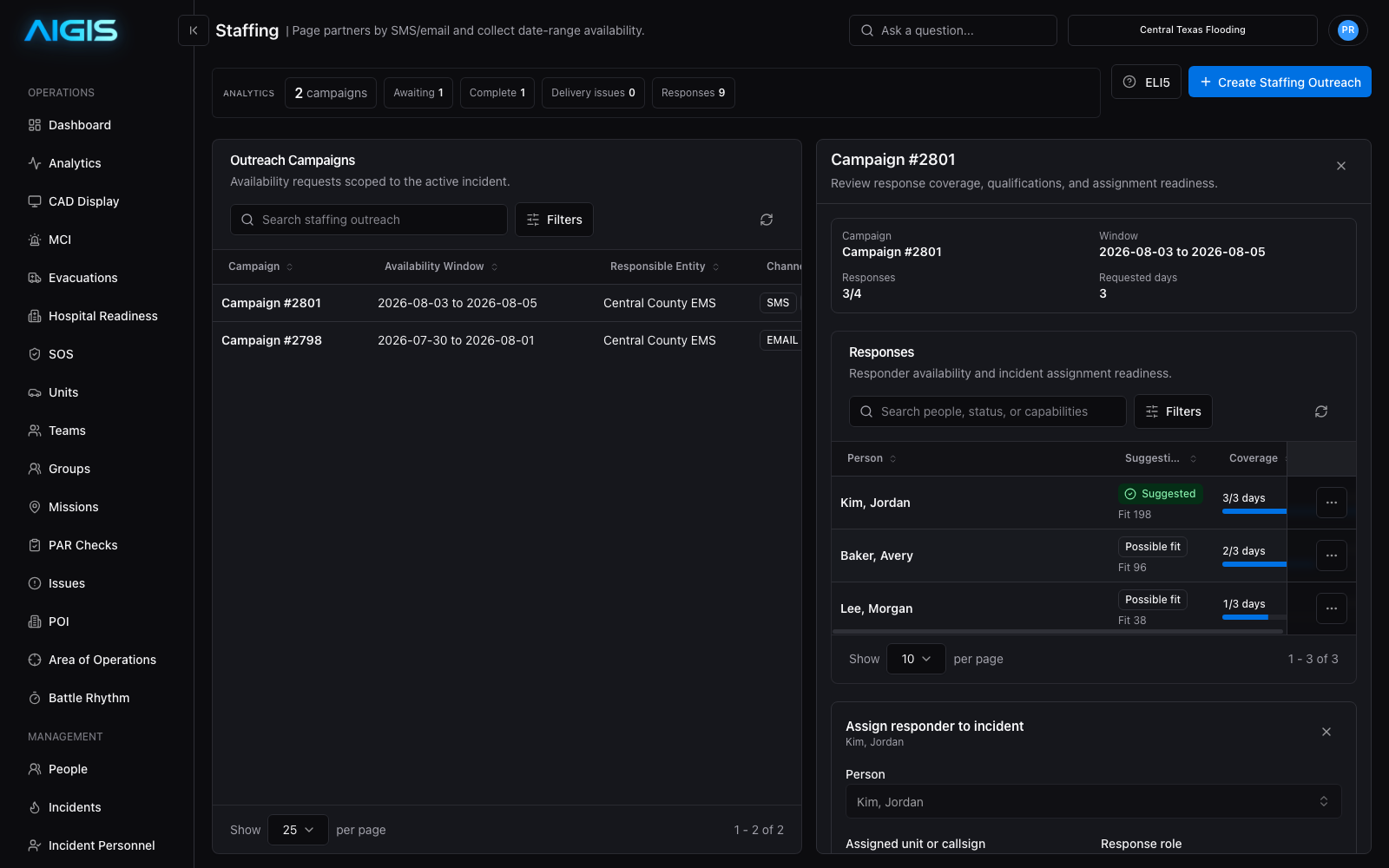
Choose recipients, request specific dates, review replies, and open the incident personnel workflow when command is ready to assign someone.
Select a responsible entity, review its people, and use maintained attributes to narrow the list when that supporting data is available. The final audience remains visible and explicitly selected before outreach is sent.
The personal outreach link opens the request context and its date window. A responder selects every date they report as available, reviews the selection, and confirms before the response is recorded.
The outreach link opens a focused availability page rather than asking the responder to navigate the Command workspace.
Responders can mark every available date in the requested window, confirm the selection, and update it while the request remains open.
The link authorizes the staffing-response task only. It is not a general platform session or a responder account.
Command groups delivery and reply rows by responder, compares selected dates with the requested window, distinguishes full requested-date coverage, and can include maintained record context in response ordering. Current incident assignment state remains visible, and operators can open the assignment workflow from the response view.
Scope
Each campaign is tied to the active incident and a responsible entity, keeping the request with the response record.
Audience
Narrow the directory with maintained person attributes when that data is available, then explicitly select every recipient before sending.
Window
Define a start and end date. Each responder selects the dates they report as available instead of returning an unstructured yes or no.
Action
Review the response and requested-date coverage, then open the incident personnel workflow to create or edit an assignment.
Staffing outreach and replies appear in supported recent activity. Once assigned, the incident personnel record tracks role, status, shifts, and response history.
It collects responder-reported dates and supports incident assignments. It does not verify credentials, approve deployment, or replace workforce scheduling.
Filters use maintained person attributes to help narrow the directory. They do not independently verify credentials, readiness, or deployment authority.
Selected dates record what a responder submitted for that request. They do not guarantee attendance, travel, acceptance, or continued availability.
AIGIS can retain sent, skipped, failed, or partial-failure delivery state. A successful send does not prove that a recipient opened or understood the request.
Requested-date coverage helps operators compare replies. A person is assigned only when an authorized operator completes the incident personnel workflow.
The workflow coordinates incident availability and assignments. It is not payroll, timekeeping, overtime, benefits, or a complete workforce-scheduling system.
The bearer link is limited to the response task and can become unavailable or expire. Recipients should treat it as sensitive until the request is closed.
AIGIS Command
See recipient targeting, SMS and email outreach, the personal date-selection experience, response coverage, and the operator-controlled incident assignment workflow using your organizational structure.