
AIGIS Field
Respond from the field
Receive and submit a PAR response for the active unit. Authorized responders can also request a check from the map.
Run immediate or scheduled PAR checks, review unit-reported personnel counts, maintain incident personnel and recorded shifts, and track ICS 214 expected-day completion from the browser-based AIGIS Command platform.
Respond from the field
Receive and submit a PAR response for the active unit. Authorized responders can also request a check from the map.
Maintain live operational context
Keep unit and PAR state beside the live map, missions, and other command-post work.
Run and review accountability
Start checks, review incident personnel and recorded shifts, and keep expected ICS 214 reporting visible.
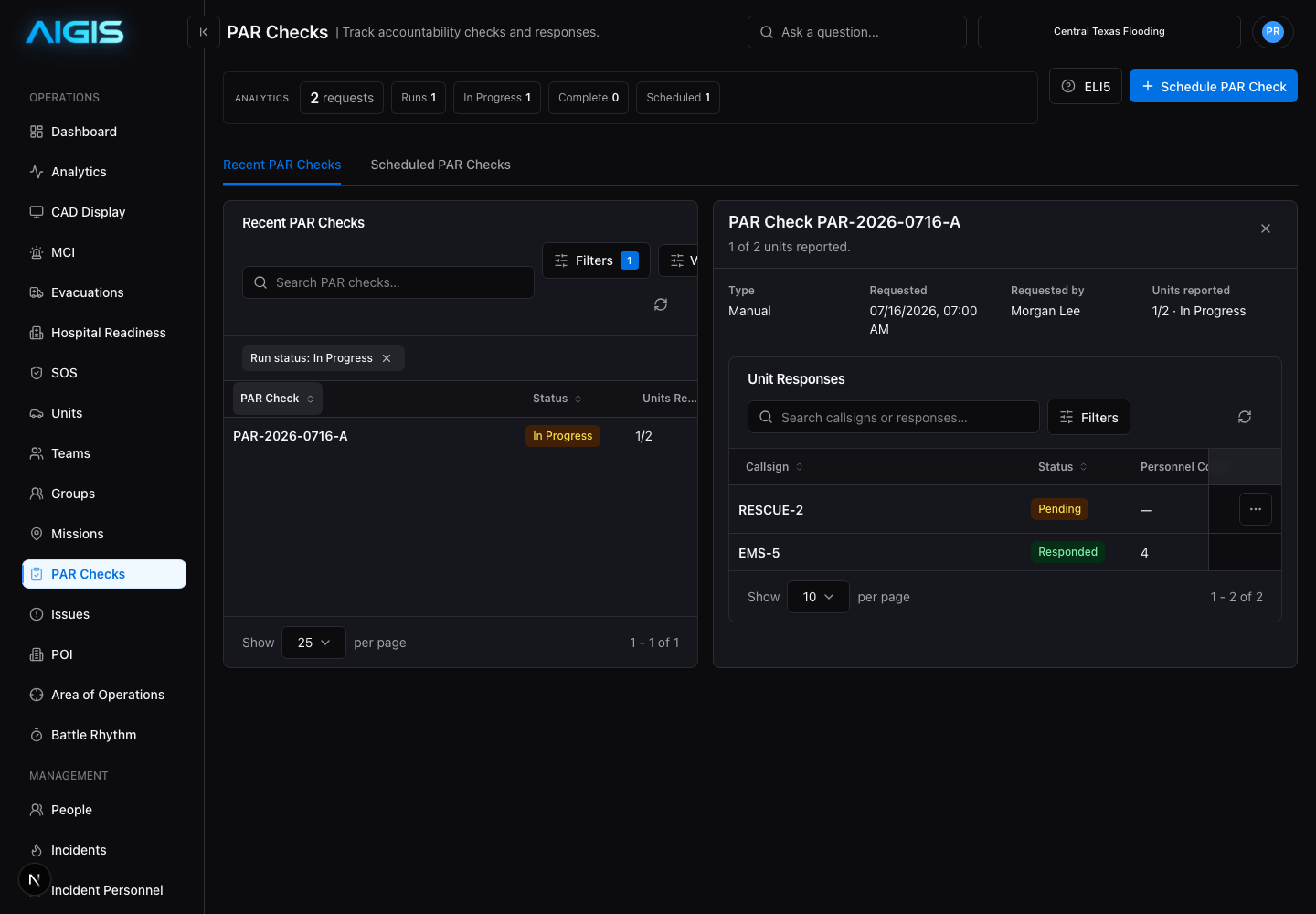
Send an immediate or scheduled PAR check to selected units. Command shows each reported personnel count and keeps unanswered requests visible.
Select
Build the check around selected units in the active incident rather than a disconnected contact list.
Run
Start an immediate check or configure one-time or recurring daily timing for the selected units.
Report
A responder in Field enters the current personnel count associated with the active assigned unit.
Review
Inspect run progress and the integer personnel count reported by each responding callsign.
Follow up
When authorized, create a new request for a unit that has not yet responded and keep the gap visible.
Review who is recorded on the incident, the unit and response role assigned to them, and the shift periods that form their operational history.
Responder and incident assignment
Assigned unit or callsign
Recorded response role
On-shift or off-shift state
Last shift start and end
Recorded worked-time total
Preloaded, activated, demobilizing, or demob-complete state
Shift history with authorized start, end, manual, and edit actions
Shift durations reflect recorded operational intervals. They are designed for incident accountability and service history, not payroll or independent proof of physical presence.
Keep daily ICS 214 record completeness in view for the selected incident without reconstructing the gap from separate spreadsheets and messages.
AIGIS derives expected dates from recorded operational periods and supported mission participation.
Compare expected dates with submitted report dates to see completed versus expected counts, percentage, and remaining dates.
Review submitted ICS 214 documents linked to the selected incident and open the responder record for detail.
Open an email reminder when a responder address is available; content review and approval remain with the organization.
PAR activity, incident participation, response roles, unit or callsign context, recorded shifts, and supported operational events remain part of the authorized incident record. Command service history is limited to recorded operational facts; evaluations and private personnel notes are not included.
Explore the service-history storyAIGIS displays configured PAR, staffing, shift, and ICS 214 status. Your agency remains responsible for policy, report quality, approvals, and recordkeeping.
A PAR response records the integer personnel count submitted for the responder’s current assigned unit.
A saved PAR request does not certify notification receipt; request-creation warnings are separate from confirmed device delivery.
Worked duration is derived from recorded shift intervals, including an open shift that continues to accrue.
ICS 214 status compares expected dates with submitted dates. It does not certify report quality, agency approval, or regulatory compliance.
Request access for PAR, incident personnel, shifts, and ICS 214 using your organization’s unit structure, reporting cadence, and authorized roles.